

Commercial HVAC Repair: Practical Tips for Property Managers
Quick Answers for Property & Facility Managers
What should property managers do first during a commercial HVAC repair issue?
Start with the basics: confirm the complaint, check the BAS or thermostat, inspect filters, drain lines, breakers, and visible leaks, then document the fault. For commercial HVAC repair, fast triage helps reduce downtime, protects tenants, and prevents small issues from becoming larger equipment failures.
How do you decide between commercial HVAC repair and replacement?
Use age, repeated failures, parts availability, and operating cost. If a rooftop unit, chiller, or VRF system is requiring frequent repairs, losing efficiency, or facing major component failure, compare the repair quote against lifecycle value, energy savings, and the risk of additional downtime.
What systems are most common in commercial HVAC repair projects?
The most common commercial HVAC repair targets are rooftop units, chillers, air handlers, pumps, controls, and VRF systems. Building type matters: retail and offices often rely on rooftop units, healthcare uses tighter control and redundancy, and larger campuses may depend on chillers and centralized hydronic systems.
Commercial HVAC repair starts with fast, documented triage
For property managers, facility managers, and building owners, commercial HVAC repair is less about one broken part and more about protecting tenant comfort, uptime, and operating expense. Commercial HVAC service covers inspection, maintenance, repair, replacement, and operational verification for building-scale systems serving non-residential facilities, including controls and airflow components that affect performance.[1] That means every repair decision should begin with a clear fault description, a documented timeline, and a basic check of system status before a contractor arrives.
Start by asking four questions: What is not working, where is the problem occurring, when did it start, and what changed before the failure? If the issue is building-wide, use the BAS or thermostat trends to see whether the system is responding normally.[4] If the issue is localized, note the space, unit ID, and any alarms, odd noises, odors, or leaks. This reduces repeat dispatches and helps your service partner arrive with the right parts and diagnostic plan.
- Confirm the complaint in the affected zone.
- Check BAS points, schedules, and setpoints.
- Look for tripped breakers, dirty filters, blocked drains, or visible leaks.
- Record the equipment tag, model, serial number, and location.
- Take photos of the fault and any obvious damage.
Commercial HVAC repair checklist for rooftop units, chillers, and VRF systems
Different systems fail in different ways, and your response should reflect the equipment type. Rooftop units, chillers, and VRF systems each serve different building profiles, from smaller office and retail properties to larger campuses and healthcare facilities. In commercial environments, standardized maintenance and repair procedures are used to improve consistency and reduce avoidable errors.[1]
Rooftop units
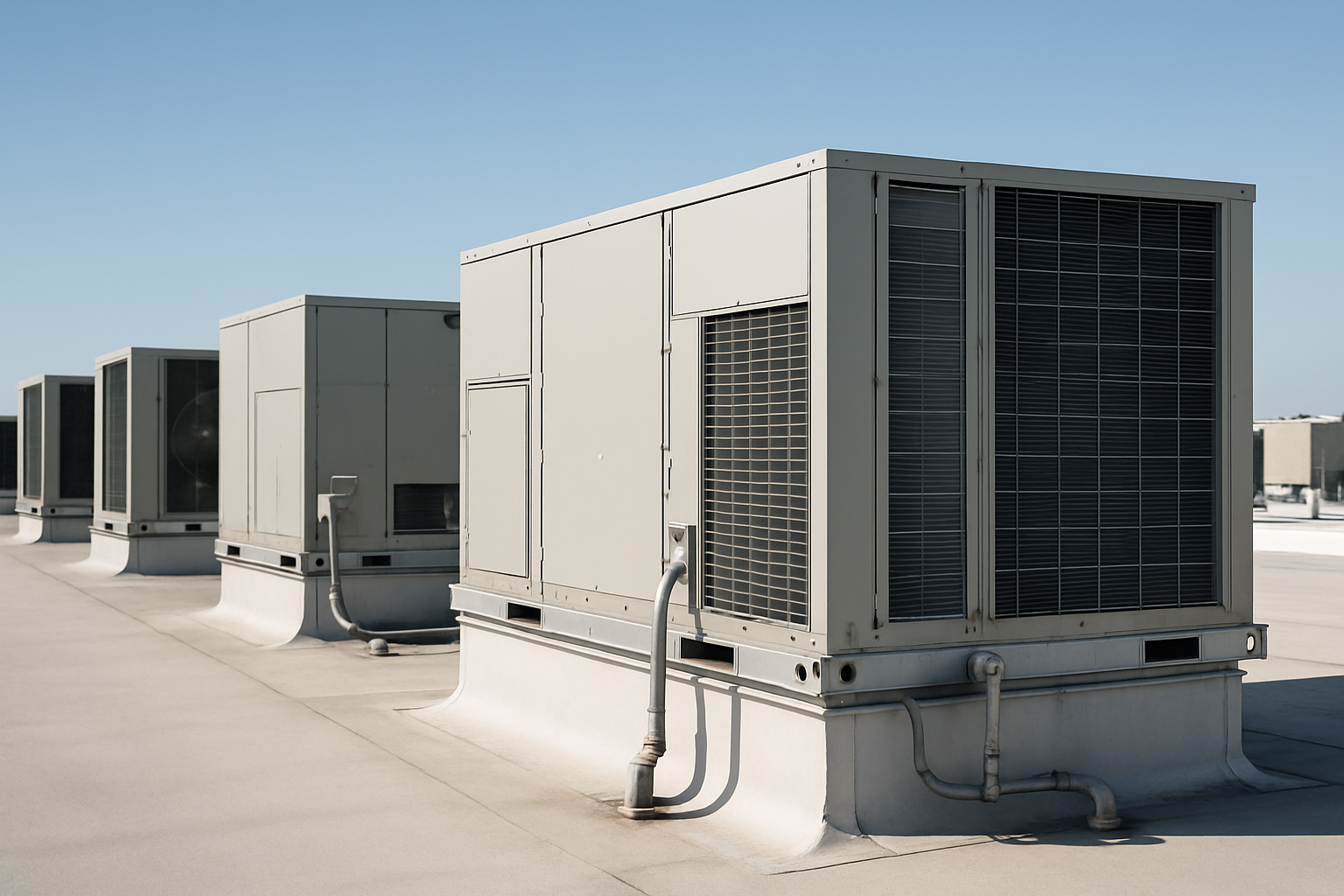
Rooftop units are common in retail, office, warehouse, and light industrial properties, especially in the 50-500+ ton range when multiple units serve large floor plates or multiple tenants. For these systems, check belts, filters, condenser coils, economizers, drain pans, drains, contactors, and fan operation. A clogged filter or dirty coil can increase strain, reduce airflow, and trigger temperature complaints long before a compressor fails.[4]
- Inspect filters and replace them if loaded.
- Clean condenser and evaporator coils with approved non-corrosive agents.
- Verify fan operation, belts, and pulleys.
- Test economizer operation and outside air damper movement.
- Check condensate drainage and clear standing water.
Chillers
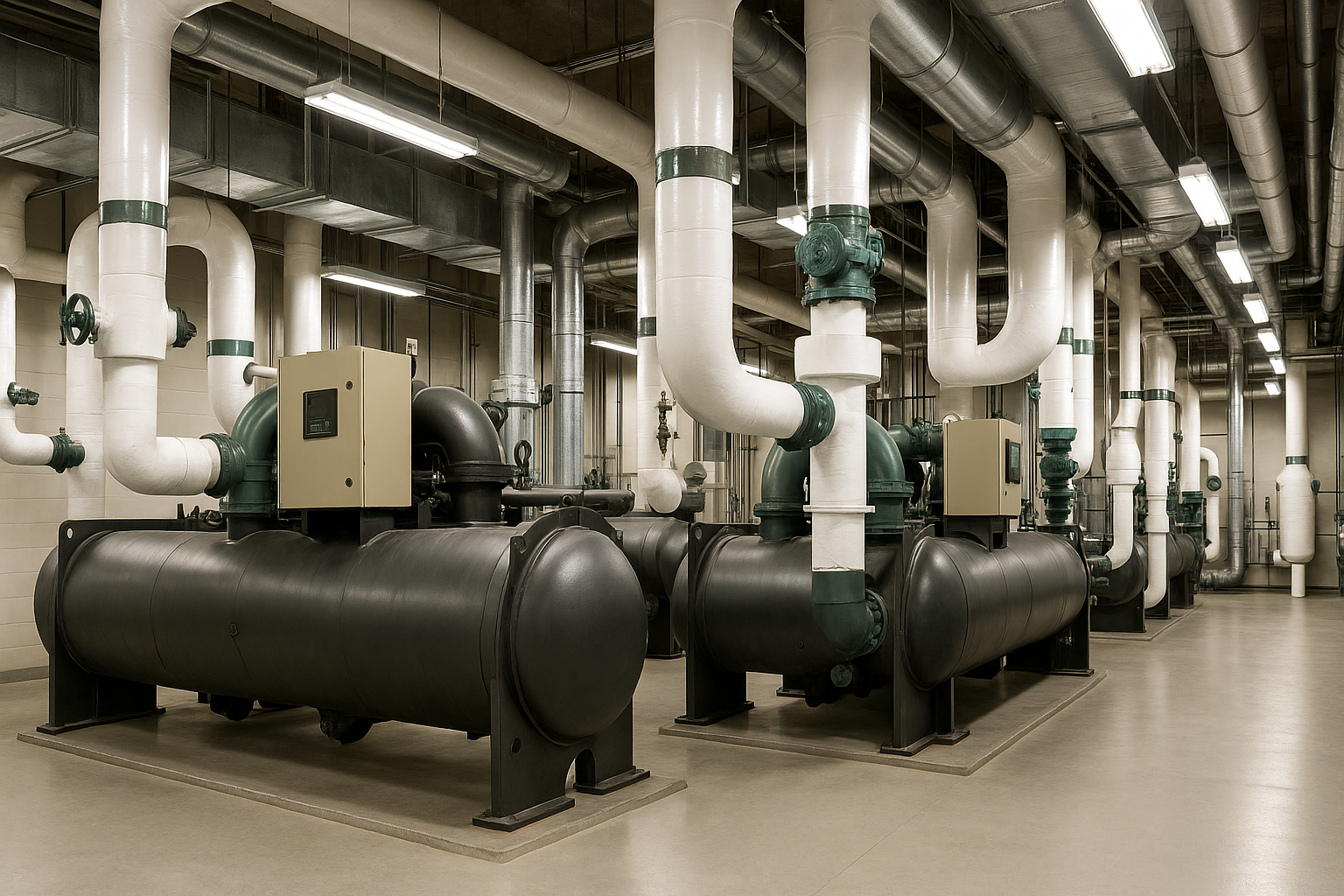
Chillers are often found in larger office towers, hospitals, data-sensitive facilities, and campuses with centralized cooling. Because chiller plants support large tonnage loads, a repair decision should be based on the full impact of downtime, not just the part price. Document oil condition, refrigerant alarms, pump performance, tube fouling, and control faults. If the chiller is short cycling, losing capacity, or showing repeated alarm history, capture trend data before resetting anything.
- Review alarm history and trend data before restarting.
- Inspect pumps, valves, strainers, and flow conditions.
- Check tubes, coils, and heat exchanger cleanliness.
- Verify sensors and controls calibration.
- Confirm redundancy and backup capacity before extended repairs.
VRF systems
VRF systems are increasingly common in offices, hotels, mixed-use buildings, and healthcare-adjacent spaces where zoning and part-load efficiency matter. Repairs often involve refrigerant circuit issues, branch control faults, sensors, or communication problems between indoor and outdoor units. Because VRF performance depends on controls and refrigerant balance, a repair should include a review of alarms, line sets, zone behavior, and communication errors across the system.
- Document which indoor zones are affected.
- Review controller alarms and communication faults.
- Check refrigerant piping, insulation, and leak indicators.
- Verify sensor placement and setpoint logic.
- Confirm the repair does not create imbalance in other zones.
Step-by-step commercial HVAC repair process for facility teams
A repeatable process improves response time and reduces costly guesswork. Preventive maintenance resources from building-efficiency programs emphasize routine servicing to improve performance, save energy, and prolong equipment life.[5] The same discipline should guide repair response when equipment fails.
- Log the issue immediately. Record the complaint, time, zone, and business impact, such as tenant disruption, product risk, or temperature excursions.
- Stabilize the space. If needed, shift loads, close affected zones, or deploy temporary cooling or heating to protect operations.
- Perform a visual check. Look for dirty filters, clogged drains, loose wiring, unusual vibrations, and signs of water damage.
- Pull operating history. Review BAS trends, runtime hours, alarm logs, and setpoint changes to identify the root cause.
- Authorize the diagnostic scope. Decide whether the issue is a low-cost repair, a component replacement, or a broader system evaluation.
- Repair and verify. After work is complete, confirm airflow, temperature control, drainage, electrical stability, and alarm clearance.
- Document the closeout. Save photos, parts used, labor notes, and follow-up recommendations for lifecycle planning.
How to reduce repeat commercial HVAC repair calls
Repeat failures are expensive because they multiply labor, after-hours premiums, and tenant disruption. Commercial HVAC preventive maintenance guidance consistently recommends checking system status, temperature setpoints, visible leaks, filter condition, coil cleanliness, electrical connections, and refrigerant condition as part of routine care.[4][5] Those same checkpoints should be used after a repair to make sure the original issue was actually solved.
- Replace dirty filters before they restrict airflow again.
- Clean condenser and evaporator coils to reduce compressor strain.
- Verify thermostat and sensor calibration after any control-related repair.
- Clear drain pans and lines to prevent overflow and water damage.
- Inspect belts, pulleys, and motors for wear before returning equipment to service.
- Track repeat service calls by asset so chronic problems are easy to spot.
For buildings with dusty environments, frequent occupancy swings, or critical operations, inspection intervals may need to be tighter than standard quarterly or seasonal schedules.[4] A warehouse with high particulate load, for example, may need more aggressive filter management than a typical office property.
Cost and ROI context for commercial HVAC repair decisions
For property managers and owners, the real cost of commercial HVAC repair is not just the invoice. It also includes tenant complaints, overtime, emergency dispatches, energy waste, and potential downtime. Preventive maintenance is specifically promoted to improve performance, save energy, and prolong equipment life, which is why a well-timed repair can have a better ROI than waiting for a catastrophic failure.[5]
Use a simple decision framework: if the repair restores capacity, reduces repeat alarms, and extends useful life at a predictable cost, repair is usually the better short-term move. If a rooftop unit, chiller, or VRF system has recurring failures, unavailable parts, or major component damage, the business case should include lifecycle cost, efficiency loss, and the risk of another interruption.
- Compare the repair quote to the cost of lost occupancy or production time.
- Estimate savings from avoided emergency calls and temporary rentals.
- Factor in energy waste from dirty coils, poor controls, or airflow restriction.
- Ask for a repair-versus-replace analysis when a major component fails.
- Track equipment age, service frequency, and remaining useful life in a CMMS.
Commercial HVAC repair planning by building type and operating risk
The best repair strategy depends on the building’s use. Offices may prioritize comfort complaints and tenant retention, retail properties may focus on keeping customer areas stable, healthcare facilities need tighter temperature and ventilation control, and warehouses often need reliable large-zone conditioning with fewer but more disruptive failures. Commercial HVAC work is defined by building-scale systems, non-residential occupancy, ventilation requirements, and controls integration, so the operating risk is never just mechanical.[1]
- Offices: prioritize morning startup issues, conference room hot spots, and BAS scheduling errors.
- Retail: prioritize sales-floor comfort, curb appeal, and after-hours repair access.
- Healthcare: prioritize continuity, filtration, alarms, and strict verification before return to service.
- Warehouses: prioritize large-volume airflow, rooftop unit reliability, and rapid response to temperature swings.
For each property type, create a short emergency playbook with contact lists, equipment maps, shutdown authority, and tenant notification templates. That preparation can cut response time and improve decision-making when a repair request escalates into an operational issue.
Frequently Asked Questions
How much should a building owner budget for commercial HVAC repair planning?
Budgets should reflect equipment mix, age, occupancy, and criticality rather than a single national number. A building with rooftop units may need different reserves than a campus with chillers or a multi-zone VRF system. The practical approach is to fund routine maintenance, an emergency reserve, and a capital plan so major repairs do not force reactive decisions.
When does commercial HVAC repair become a replacement decision?
Repair becomes a replacement conversation when failures are frequent, parts are hard to source, efficiency is poor, or the system cannot reliably support the building load. For property managers and owners, the key question is whether the repair restores predictable service or only postpones a larger capital event.
What records should facility managers keep after a commercial HVAC repair?
Keep the fault description, BAS trends, photos, parts replaced, labor notes, test results, and any follow-up recommendations. These records help identify repeat failures, support warranty claims, and improve future budget planning. They also make it easier to compare repair frequency across rooftop units, chillers, and VRF systems.
How does commercial HVAC repair affect compliance and risk?
Repair work can affect ventilation, filtration, drainage, and temperature control, which are all operational risk points in commercial buildings. Healthcare, retail, and office environments may have different internal standards, but the common requirement is to verify that the system is safe, stable, and functioning as intended before returning it to service.
What should I ask before approving a commercial HVAC repair vendor?
Ask what diagnostic steps they will perform, whether they will verify the repair after completion, what parts are needed, how they handle emergency response, and whether they can document findings for your CMMS. For larger assets like chillers and VRF systems, request experience with the exact equipment type and controls platform.
Related Reading on My HVAC Tech
- Sussman EWx Electric Boilers Expand for Commercial Buildings
- Chiller Maintenance: Protecting Your Largest HVAC Investment
Find a Qualified Commercial HVAC Contractor
Need help acting on this? Browse vetted commercial HVAC contractors in your area, or explore commercial HVAC services like preventive maintenance, retrofits, and emergency repair. Are you a contractor? List your business on My HVAC Tech to reach property and facility managers actively searching for help.
