

Commercial Air Conditioning Maintenance: Practical Guide for Large Buildings
Quick Answers for Property & Facility Managers
What does a commercial air conditioning maintenance program include for a large building?
Commercial air conditioning maintenance for offices, healthcare, and industrial sites typically includes filter changes, coil cleaning, refrigerant checks, electrical inspections, lubrication, condensate management, controls testing, and documentation of performance trends.[1][3][6] Most experts recommend at least biannual professional service plus monthly inspections for critical sites.[2][4]
How often should commercial air conditioning systems be serviced in a commercial building?
Most authorities recommend servicing commercial HVAC systems at least twice per year—once before the cooling season and once before heating.[2][4][3] High‑load facilities, critical healthcare, and data environments often add quarterly or monthly inspections to protect uptime, comply with policies, and keep energy costs under control.[1][7]
What is the ROI of proactive commercial air conditioning maintenance for property managers?
Preventive maintenance reduces energy use, avoids major failures, and extends equipment life, which typically costs far less than emergency repairs or premature replacement.[2][4][7] For property managers, ROI shows up as lower utility spend, fewer tenant complaints, and stronger asset value due to documented care and predictable budgeting.[1][6]
Why commercial air conditioning maintenance is a strategic asset decision
For property managers, facility teams, and building owners, commercial air conditioning maintenance is not just a technical task—it is an asset protection and risk-management strategy. Commercial HVAC systems in offices, retail centers, healthcare facilities, and warehouses represent some of the largest capital investments and energy line items in a building.[6][7]
According to industry guidance, commercial HVAC maintenance is the organized inspection, servicing, and verification of systems so they continue to operate within design and safety parameters over time.[6] That includes air distribution, refrigerant circuits, filtration, controls, and safety-related components.[6] Federal and utility best-practice resources emphasize that proactive maintenance improves performance, saves energy, and prolongs equipment life.[7]
For 50–500+ ton plants—whether built around rooftop units (RTUs), air‑cooled chillers, water‑cooled chillers, or VRF/VRV systems—skipping maintenance multiplies risks:
- Higher energy and demand charges as coils foul and refrigerant charge drifts.[2][3][7]
- Unexpected compressor or fan failures that disrupt tenants or critical services.[2][4]
- Moisture and IAQ problems from clogged condensate drains or dirty filters.[1][3][5]
- Difficulty justifying budgets or replacements without documented condition and trending data.[1][6]
Viewed through a portfolio lens, a structured maintenance program is often the lowest-cost way to stabilize operating expenses and extend the life of expensive cooling equipment.
Core tasks in a commercial air conditioning maintenance checklist
While each equipment type has its own specifics, most authoritative commercial HVAC maintenance checklists share a core group of tasks.[1][3][4]
System-wide preventive maintenance tasks
A comprehensive commercial air conditioning maintenance checklist for a multi-tenant building or campus typically covers:[1][3][5]
- Air filters – Inspect and replace filters to maintain airflow and indoor air quality.[1][3] In many commercial settings this is monthly or quarterly, depending on load and environment.[2][4]
- Coils – Clean condenser and evaporator coils to prevent efficiency losses due to dust and debris.[1][3][5]
- Belts, pulleys, and moving parts – Inspect for wear, alignment, and proper tension; lubricate motors and bearings as required.[1][5]
- Electrical connections – Tighten terminals, inspect control panels, and test safety devices to avoid failures and hazards.[1][3][5]
- Refrigerant levels – Check charge, look for leaks, and verify sight glass or subcooling/superheat as appropriate.[1][2][3]
- Condensate management – Inspect and clean drain pans and condensate lines to prevent clogs, overflow, and microbial growth.[1][3][5]
- Controls and thermostats – Verify thermostat accuracy, sequence of operations, and proper start/stop and emergency controls.[1][3][5]
- Ductwork and ventilation – Inspect for dust, blockages, and visible moisture/mold; verify air exchange and damper operations.[3][5]
For larger plants, some providers also recommend oil analysis on big compressors and constant monitoring of motor starters and electrical quality.[2]
Pre‑cooling season commercial AC maintenance checklist
Before peak summer loads, property and facility managers should ensure a pre‑cooling season inspection that includes:[1][2][5]
- Cleaning outdoor condenser coils and removing debris from around RTUs or air‑cooled chillers.
- Verifying refrigerant levels and checking for leaks.
- Inspecting compressors for abnormal noise, overheating, or oil stains.
- Confirming proper airflow and cleaning blower components as needed.[3]
- Testing controls and sensors for accurate cooling response and staging.
- Inspecting electrical connections and components under load.
For facilities with boilers or combined systems, a similar pre‑heating season checklist applies for heating components.[1][3][4]
Maintenance specifics by equipment type and tonnage range
Commercial buildings typically use three main cooling architectures: packaged rooftop units, centralized chiller plants, and variable refrigerant flow (VRF) systems. Each has its own maintenance profile and cost/ROI implications.
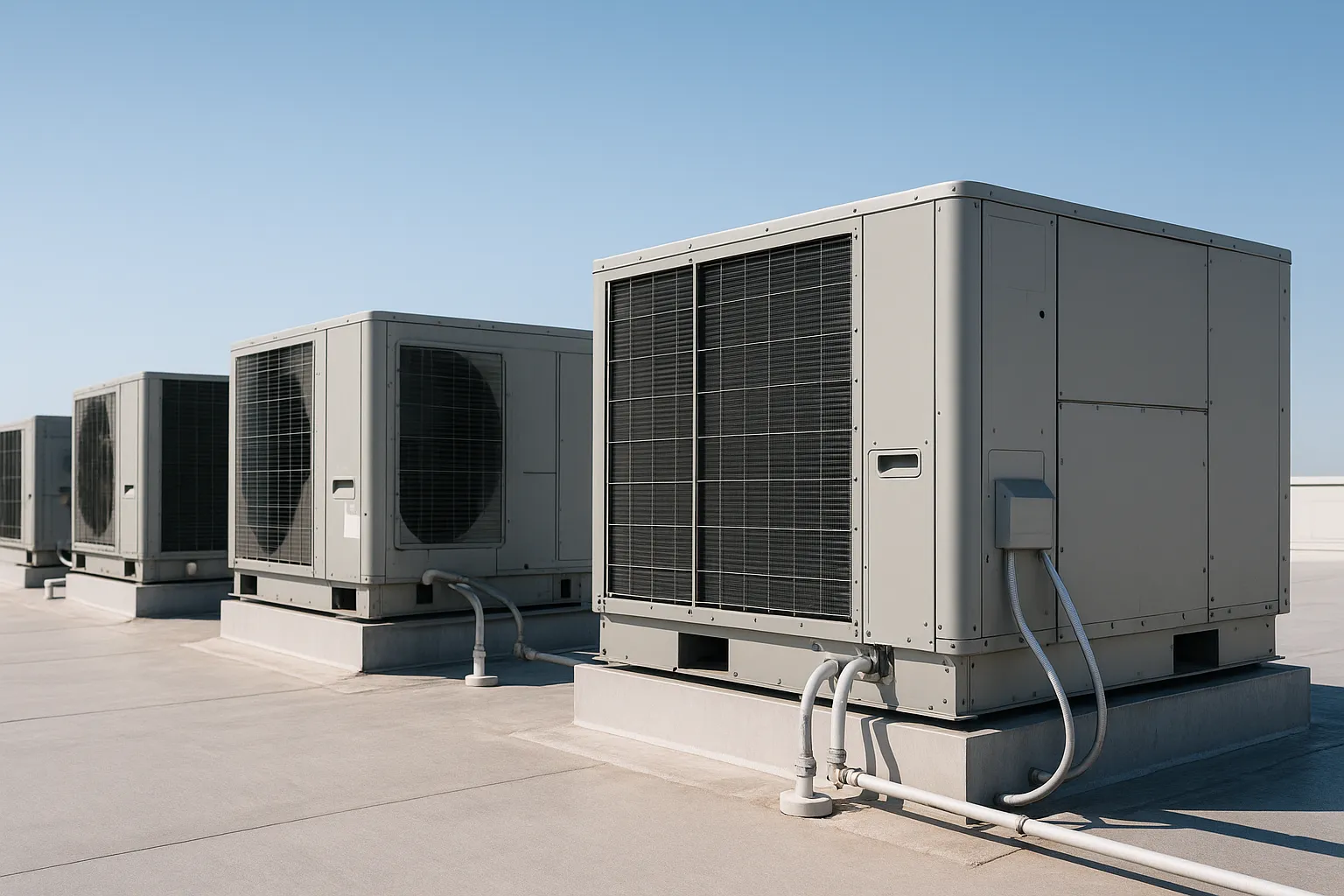
Packaged rooftop units (RTUs): 5–60+ tons per unit
Rooftop units are common in low‑ to mid‑rise offices, retail, and light industrial spaces. A typical site may have multiple 10–30 ton units aggregating to 50–300 tons of capacity.
Key RTU maintenance actions for managers to verify with their service provider include:[1][3][4]
- Quarterly filter replacement and visual inspection of cabinets and roof curbs.
- Cleaning condenser and evaporator coils at least annually, more often in dirty environments.[3][5]
- Checking economizer dampers and actuators to ensure free cooling works correctly.
- Inspecting fan belts, pulleys, and bearings; adjusting belt tension and lubricating where applicable.[1][5]
- Verifying electrical connections, contactors, and overloads; testing disconnects.
- Confirming refrigerant charge and suction/discharge pressures match manufacturer guidelines.[1][2]
Because RTUs are exposed to weather and rooftop debris, neglected units commonly suffer from coil fouling, corroded electricals, and failed economizers—all of which increase energy use and trigger hot/cold calls.[2][3]
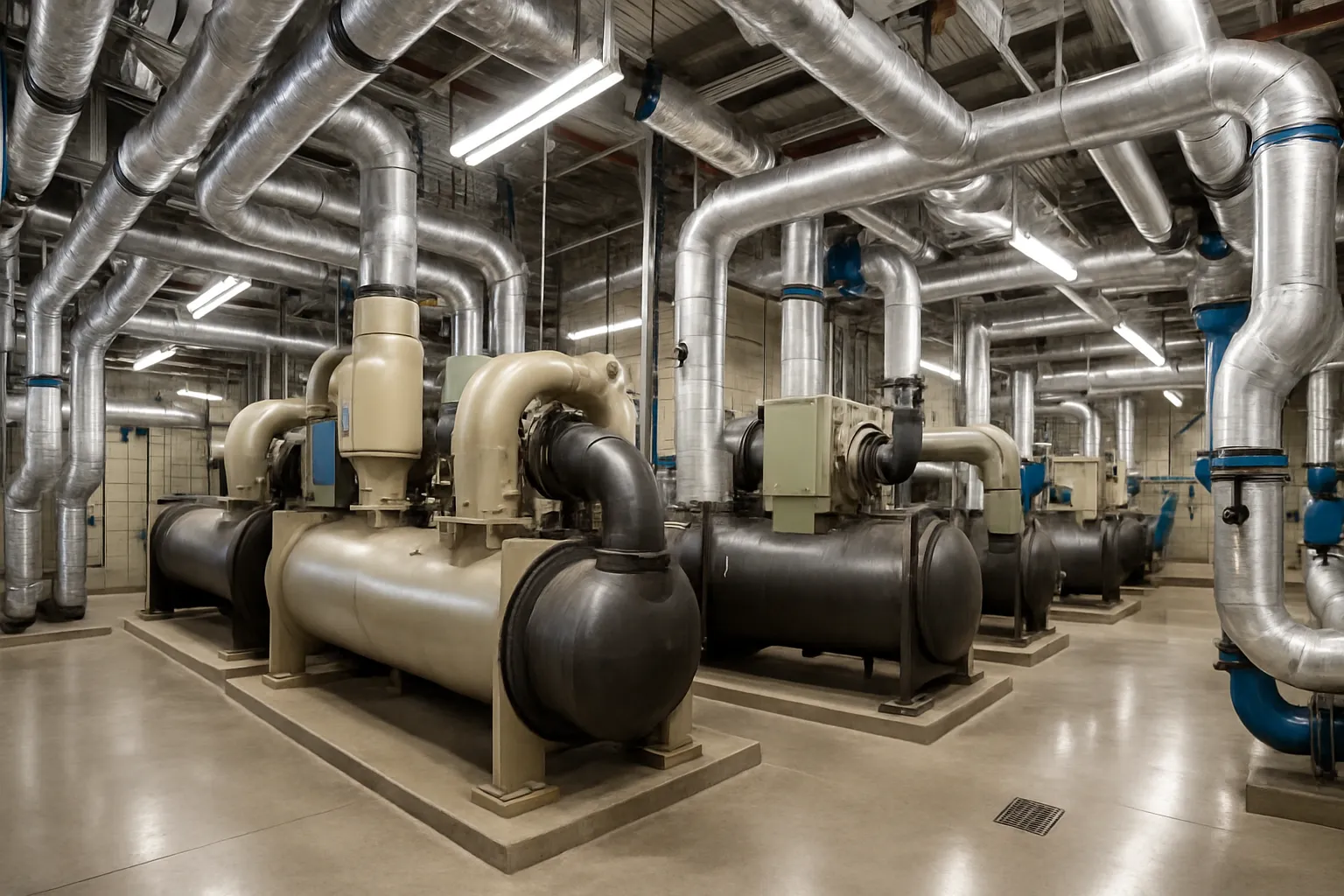
Chiller plants: 50–500+ tons
For higher load office towers, hospitals, labs, and campuses, centralized chilled water plants often deliver 50–500+ tons via air‑cooled or water‑cooled chillers, cooling towers, and air handlers. Best-practice sources for large systems emphasize:[2][7]
- Regular cleaning of condenser and evaporator tubes or coils to maintain heat-transfer efficiency.
- Monitoring refrigerant charge, compressor performance, and approach temperatures.
- Inspecting pumps, strainers, and valves; ensuring correct flow rates and delta‑T.
- Maintaining cooling towers (where present) for scale, biological growth, and mechanical wear.
- Conducting oil analysis on large compressors to detect wear or contamination early.[2]
Because chiller plants are capital-intensive, planned maintenance and trending (kW/ton, chilled-water temperatures, runtimes) are critical for justifying future upgrades and avoiding catastrophic failures.[6][7]
VRF / VRV systems in multi‑tenant spaces
Variable refrigerant flow systems are increasingly common in Class A offices and healthcare settings due to zoning flexibility and energy performance. Maintenance focuses on refrigerant circuit integrity and controls.
- Periodic verification of refrigerant charge and leak checks across distributed piping.[1][3]
- Cleaning indoor and outdoor coils and ensuring fans are balanced and free of debris.[3][5]
- Checking condensate drains on indoor cassettes and fan coils for clogs or leaks.[1][5]
- Testing communication networks, controllers, and indoor unit setpoints for correct operation.[1][6]
Because VRF uses long refrigerant line sets, proper leak detection and documentation are especially important for compliance, indoor air quality, and manufacturer warranty.
Service frequency and how to structure a maintenance plan
Most expert sources recommend at least biannual professional commercial HVAC servicing, typically in spring for cooling and fall for heating.[2][3][4][8] Many commercial programs layer in monthly or quarterly activities for higher uptime and better documentation.[1][4]
Recommended maintenance cadence for commercial sites
- Daily/weekly checks – Check thermostats and controls, walk critical equipment rooms, listen for unusual noises, and verify vents and intakes are unobstructed.[4]
- Monthly – Inspect and often replace filters, confirm condensate drains are clear, and visually check coils and electrical panels.[1][4]
- Seasonal (spring/fall) – Perform full tune‑ups before peak cooling and heating seasons, including coil cleaning, refrigerant checks, control verification, combustion checks (for heating), and safety tests.[2][3][4][5]
- Annual – Comprehensive professional inspection that documents equipment condition, efficiency indicators, and recommended repairs or capital projects.[1][4][6]
For mission‑critical environments (hospitals, data centers), facility teams often increase the frequency of inspections and add redundancy, analytics, and remote monitoring, guided by resources like the U.S. Department of Energy’s preventive maintenance recommendations.[7]
Cost, budget planning, and ROI for property managers
While specific dollar amounts vary by market, service level, and equipment size, there are well-documented cost and risk patterns that help managers build a business case.
Where maintenance delivers measurable ROI
- Energy savings – Dirty filters, fouled coils, and incorrect refrigerant charge can significantly increase energy use.[2][3][7] Regular cleaning and tuning reduce fan and compressor power draw, which directly lowers utility costs.
- Avoided downtime and emergency calls – Catching issues like worn belts, loose electrical connections, and minor leaks during planned visits prevents expensive emergency repairs and tenant disruptions.[1][2][4]
- Extended equipment life – Preventive maintenance helps keep systems operating within design parameters, which is a key factor in reaching expected equipment life for chillers, RTUs, and VRF systems.[6][7]
- Better budgeting and capital planning – A documented maintenance history and condition reports support long‑term replacement planning and can strengthen asset value during financing or sale.[1][6]
U.S. energy-efficiency resources consistently highlight preventive maintenance as one of the most cost-effective strategies for improving commercial building HVAC performance and reducing lifecycle costs.[7]
For property managers, the practical implication is straightforward: a predictable annual maintenance contract usually costs far less than one or two major failures on a 100‑ton chiller or multiple failed 20‑ton RTUs, not to mention the tenant dissatisfaction that follows.
How to select and manage a commercial air conditioning maintenance partner
The quality of commercial air conditioning maintenance depends heavily on the provider. Beyond pricing, property and facility managers should focus on process, documentation, and communication.
Key selection criteria for service providers
- Experience with your equipment types and tonnage – Confirm the contractor regularly maintains systems similar to yours (e.g., 50–500+ ton chillers, packaged RTUs, or complex VRF networks).[2][6]
- Documented maintenance checklists – Ask for their standard commercial HVAC maintenance checklist and verify it includes the core tasks recommended by industry resources: filters, coils, electrical, refrigerant, condensate, and controls.[1][3][4]
- Data and reporting – Ensure they provide written findings, photos, and recommendations after each visit to support your facility records and capital planning.[1][6]
- Compliance and safety practices – Verify appropriate licenses, refrigerant handling certifications, lockout/tagout procedures, and familiarity with your organization’s safety and work-permit policies.
- Preventive, not just reactive, mindset – Look for providers who emphasize performance trending, system optimization, and long-term asset health rather than one-off repairs.[2][7]
Using a CMMS or centralized work-order platform can help you standardize checklists, schedule visits, and track completion and findings across a portfolio.[1] This in turn supports stronger budgeting, tenant communication, and internal reporting.
Frequently Asked Questions
What should a commercial air conditioning maintenance contract include for a multi-tenant office or retail center?
A strong contract should specify visit frequency (typically biannual plus filter changes), detailed task lists by equipment type, emergency response terms, documentation and reporting requirements, and clear pricing for both preventive and corrective work.[1][2][4] It should also address refrigerant handling, safety practices, and expectations around energy-performance verification.[6][7]
How does commercial air conditioning maintenance affect energy costs and NOI?
Preventive maintenance improves airflow, heat transfer, and control accuracy, all of which reduce fan and compressor energy use.[2][3][7] Over time, this lowers utility spend and demand charges, supporting higher net operating income. Proactive care also reduces emergency repair costs and extends asset life, stabilizing capital expenditures for owners and investors.[4][6]
Are there compliance or risk issues if we neglect commercial AC maintenance?
Neglected systems increase risks of equipment failures, comfort complaints, and moisture or IAQ problems from clogged drains and dirty coils, which can affect occupant health and lease obligations.[1][3][5] Poor refrigerant management can also create environmental and regulatory exposure, while unsafe electrical or combustion conditions raise life-safety and liability concerns.[3][5][6]
How should facility managers prioritize maintenance across multiple sites with limited budget?
Start by ranking facilities by criticality (healthcare, data, high-revenue tenants), system age, and failure history. Focus preventive maintenance and upgrades on high-load and high-risk equipment such as large chillers and older RTUs.[2][6][7] Use consistent checklists and reporting to identify chronic issues and build data-driven capital plans across the portfolio.[1][4]
When does it make more sense to replace rather than keep maintaining older commercial AC equipment?
If units are near or past expected service life, suffer frequent failures, or show poor efficiency despite proper maintenance, a replacement analysis is warranted.[2][6][7] Tracking repair costs, downtime, and energy performance helps quantify when new high-efficiency RTUs, chillers, or VRF systems will deliver better lifecycle value than continued repairs and unplanned outages.[1][4]
Related Reading on My HVAC Tech
- Trane AirFin Heat Exchanger: What It Means for Commercial HVAC Efficiency
- Local Law 97 Explained: Compliance Guide for Commercial Buildings
Find a Qualified Commercial HVAC Contractor
Need help acting on this? Browse vetted commercial HVAC contractors in your area, or explore commercial HVAC services like preventive maintenance, retrofits, and emergency repair. Are you a contractor? List your business on My HVAC Tech to reach property and facility managers actively searching for help.


