

Commercial HVAC Preventive Maintenance Guide for Property & Facility Managers
Quick Answers for Property & Facility Managers
What is commercial HVAC preventive maintenance for office, retail, and industrial buildings?
Commercial HVAC preventive maintenance is a scheduled program of inspections, testing, cleaning, and minor repairs that keeps rooftop units, chillers, boilers, and VRF systems operating within design conditions while reducing failures and energy waste.[1][3][4] For property and facility managers, it’s the foundation of predictable comfort, budgets, and compliance.[1][4]
How often should commercial HVAC preventive maintenance be performed on my building systems?
Industry guidance recommends a layered schedule: daily/weekly visual checks, monthly filter and BAS checks, and deeper seasonal or annual inspections of coils, refrigerant circuits, and electrical components.[4][5][8] Exact frequency depends on equipment type, run hours, and environment, so managers should follow OEM guidance and a tailored site program.[3][4][8]
Does commercial HVAC preventive maintenance really save money for property owners?
Research from industry and energy-efficiency programs shows preventive maintenance improves efficiency, reduces unplanned failures, and extends equipment life, which lowers total cost of ownership.[3][7][9] For property owners, this typically means fewer emergency calls, better tenant retention, and more predictable capital planning rather than chasing reactive repairs.[4][7][9]
Why Commercial HVAC Preventive Maintenance Matters to Property & Facility Managers
For commercial office, retail, healthcare, and industrial properties, commercial HVAC preventive maintenance is the difference between predictable operations and disruptive, expensive failures. Industry resources define preventive maintenance as a structured, recurring program of inspections, testing, cleaning, adjustments, and documentation designed to keep systems operating within expected ranges and to reduce unplanned outages.[1][3][4]
Federal and industry efficiency programs note that properly maintained HVAC equipment operates more efficiently, lasts longer, and provides more reliable comfort and ventilation for occupants.[7][9] For property and facility managers, that translates into:
- Lower risk of emergency outages that disrupt tenants or critical spaces.[4][9]
- Reduced energy use by keeping components clean, tuned, and correctly charged.[3][4][7]
- Extended life of capital assets like 50–500+ ton chillers and large rooftop units.[3][7][9]
- Better indoor air quality, which is increasingly important for tenant expectations and some regulatory frameworks.[2][4]
- Stronger warranty compliance and asset documentation for future replacement planning.[1][5]
Preventive maintenance is not a single visit; it is an ongoing closed-loop process where assets are defined, conditions are measured, results are recorded, and the program is adjusted over time.[1][4]
Core Elements of a Commercial HVAC Preventive Maintenance Program
Effective commercial HVAC preventive maintenance programs share a consistent set of tasks across equipment types. Common best practices identified in multiple guides include:[2][3][4][5][8]
- Air filtration: Inspect and replace filters on a defined schedule to protect coils and maintain airflow and indoor air quality.[2][3][4][5]
- Coils and heat-transfer surfaces: Clean evaporator and condenser coils regularly to maintain heat-transfer efficiency and reduce compressor strain.[2][3][4][5]
- Refrigerant circuit checks: Verify refrigerant pressures and look for leaks or line damage on a scheduled basis.[3][4][5][8]
- Electrical inspections: Check and tighten electrical connections, inspect contactors, and look for signs of overheating or corrosion.[3][4][5]
- Moving parts: Inspect and lubricate bearings, motors, and dampers; check belts and pulleys for wear and alignment.[2][3][4]
- Condensate management: Clear drain pans and drain lines to prevent overflows, leaks, and microbial growth.[2][3][5]
- Controls and BAS: Test thermostat and sensor calibration and verify proper operation of control sequences via your building automation system.[3][4][5]
- Combustion safety (where applicable): Inspect heat exchangers and test furnace or boiler combustion to avoid safety risks.[2][4][5]
For managers, the key is to verify that every maintenance visit your contractor performs includes a documented checklist aligned with these elements and the manufacturer’s recommendations for each asset.
Step-by-Step: Building a Preventive Maintenance Plan for Your Portfolio
Industry guides recommend a structured approach for building a commercial HVAC preventive maintenance program.[1][4][5][7]
1. Audit all HVAC assets
Start by listing each piece of HVAC equipment across your buildings, including:
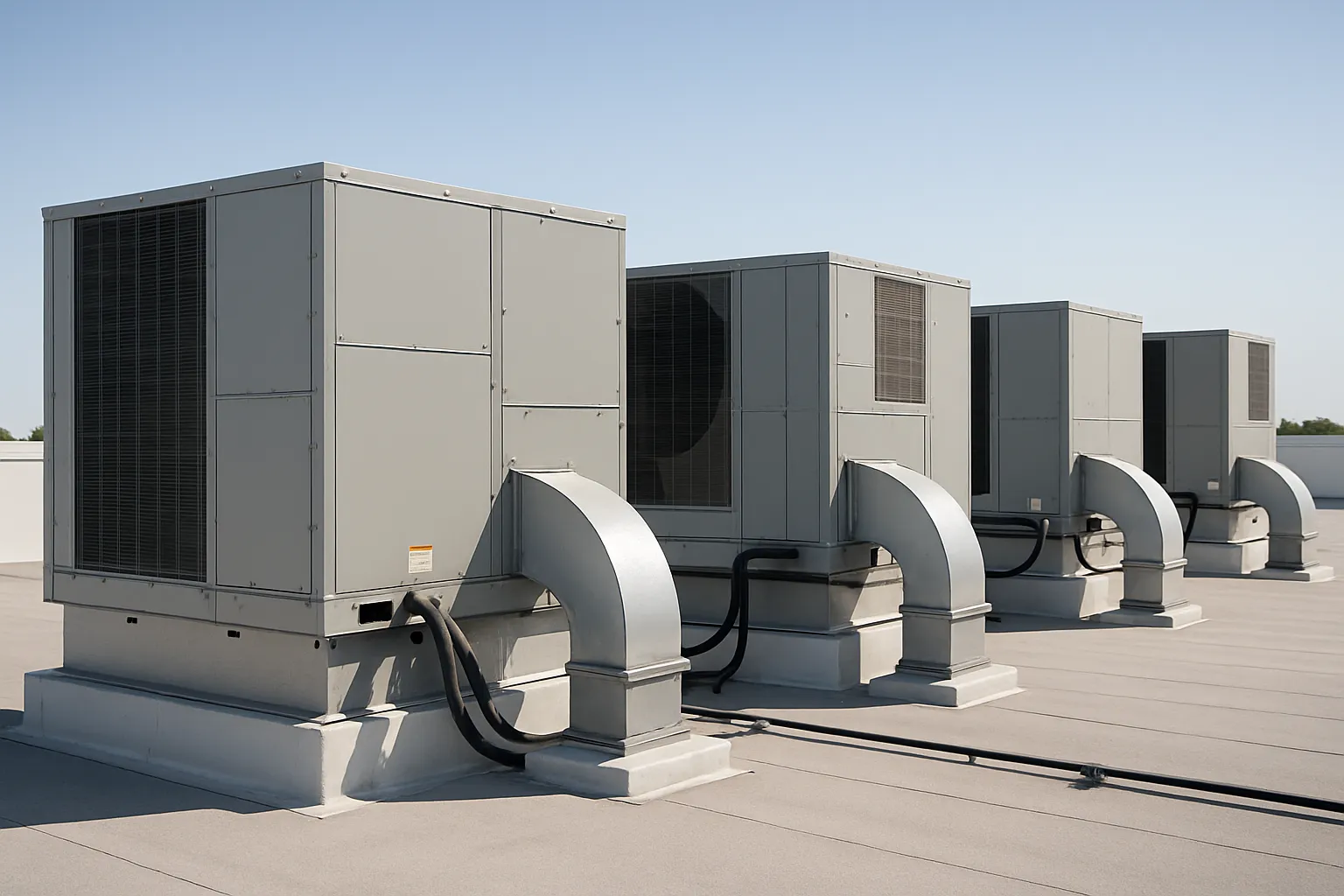
- Rooftop units (RTUs) serving office or retail zones, typically 5–60 tons each.
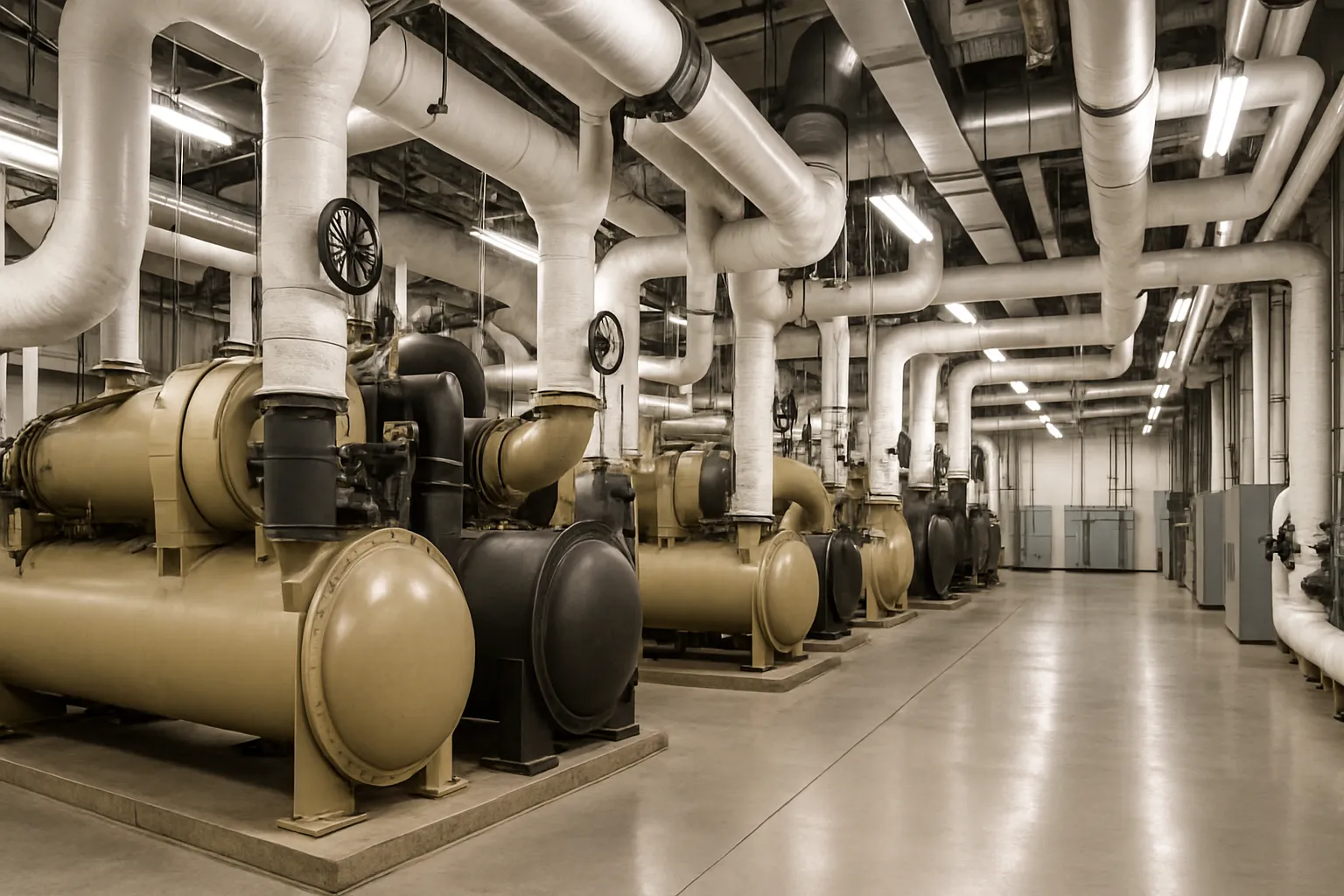
- Central chillers in the 50–500+ ton range serving air-handling units in larger facilities.
- VRF (variable refrigerant flow) systems with multiple indoor fan-coil units on shared outdoor heat pumps.
- Boilers, cooling towers, dedicated outdoor air systems (DOAS), and critical-room units.
Record model, serial number, location, tonnage or capacity, age, and known issues.[4][5] This asset inventory becomes the backbone of your maintenance and capital planning.
2. Assign frequencies and task lists
Industry resources recommend layering daily, weekly, monthly, seasonal, and annual tasks rather than relying on a single annual visit.[4][5][8]
Daily/weekly (operations team or security walk-throughs):
- Check system status via BAS or thermostats for alarms or abnormal conditions.[4]
- Verify space temperatures are within expected ranges.
- Walk key mechanical areas and roofs to look for unusual noise, vibration, smells, or visible leaks.[4][5]
Monthly:
- Inspect air filters; clean or replace based on condition and environment.[4][5]
- Clear debris around outdoor RTUs and condensing units.[4][5]
- Visually inspect drain pans and clear drains.[3][4][5]
- Check visible belts, pulleys, and guards.[3][4][5]
Seasonal (spring/summer cooling; fall/winter heating):
- Clean coils, verify refrigerant pressures, and check condensate systems before the cooling season.[2][3][4][8]
- Inspect burners, ignition systems, and heat exchangers before the heating season.[2][5][8]
- Test and calibrate thermostats and key sensors each season.[2][3][4][8]
Annual:
- Comprehensive mechanical and electrical inspection of each major asset, including megger tests or more detailed checks where appropriate.[3][4][5]
- Thorough coil cleaning, drain pan treatment, and verification of control sequences.[3][4][5][7]
- Record all work performed, readings taken, and recommendations for repairs or capital upgrades.[1][4][5]
Use a CMMS or work-order software to schedule and track these tasks, which improves consistency and recordkeeping.[4]
3. Monitor performance and refine
Review maintenance logs and performance indicators like energy use, comfort complaints, and run hours to refine your schedule over time.[1][4][7] If a particular RTU or chiller shows repeated issues, it may need more frequent preventive maintenance or a capital replacement evaluation.
Equipment-Specific Preventive Maintenance: RTUs, Chillers, and VRF
While the principles of commercial HVAC preventive maintenance are consistent, the details differ by equipment type.
Rooftop units (RTUs) in commercial buildings
RTUs from roughly 5–60 tons are common on office, retail, and light industrial roofs. Best-practice tasks include:[2][3][4][5]
- Inspecting and replacing filters on a monthly or quarterly schedule depending on load and environment.[2][3][4][5]
- Cleaning condenser and evaporator coils at least annually, more often in dirty environments.[2][3][4]
- Checking refrigerant pressures and looking for signs of oil or corrosion around piping and coils.[3][4][5][8]
- Inspecting blower and fan assemblies, verifying motor amperage, and replacing worn belts.[2][3][4]
- Testing economizer dampers and actuators where installed.
- Inspecting electrical panels for loose connections, hot spots, and contactor wear.[3][4][5]
For property managers, RTUs are often the highest-volume equipment category, so having a standardized checklist for every unit and prioritizing those serving critical or high-revenue tenants is key.
Chillers (50–500+ tons) and central plants
Large commercial and institutional buildings often rely on water-cooled or air-cooled chillers in the 50–500+ ton range serving multiple air-handling units. Best practices emphasize system-level maintenance:[7]
- Regular inspection of chiller operating parameters (temperatures, pressures, and approach) and comparison to design baselines.
- Annual or more frequent tube cleaning and inspection on water-cooled chillers to maintain heat-transfer efficiency.[7]
- Cooling tower maintenance, including basin inspections and cleaning, debris removal from strainers, and verification of proper water flow.[6][7]
- Verification of pump operation, valve exercising, and strainer cleaning to maintain flow.[6][7]
- Monitoring water treatment to minimize scale and corrosion in closed and open loops.
Because chiller downtime can affect entire buildings, many managers choose enhanced preventive maintenance and remote monitoring for central plants to reduce risk.
VRF systems in offices, hotels, and healthcare
VRF systems provide flexible zoning and are increasingly common in offices, hotels, and healthcare facilities. While manufacturer-specific procedures apply, industry preventive maintenance typically includes:[3][4]
- Cleaning or replacing filters and cleaning indoor unit coils.
- Inspecting outdoor heat pumps for coil cleanliness and unobstructed airflow.
- Verifying refrigerant pressures and temperatures fall within manufacturer ranges.
- Checking condensate pumps and drains at each indoor unit.
- Testing communication between indoor units, outdoor units, and central controllers.
For managers, VRF systems centralize a lot of capacity in shared refrigerant circuits, so refrigerant leak detection and prompt response are especially important.
Costs, ROI, and Budgeting for Preventive Maintenance
Industry sources highlight that preventive maintenance reduces total lifecycle costs by improving efficiency and extending equipment life, even though it requires recurring budget.[3][7][9] For property and facility managers, the financial lens should account for:
- Avoided emergency calls: Emergency repairs are typically billed at higher labor rates and may require premium parts procurement.
- Energy savings: Clean filters and coils, correct refrigerant charge, and tuned controls reduce fan and compressor energy use.[3][4][7]
- Extended equipment life: Keeping components within design conditions reduces premature failures and capital replacements.[3][7][9]
- Tenant and occupant impacts: Better temperature and humidity control lowers complaints and can support tenant retention in competitive markets.
Energy-efficiency and building-performance programs note that structured preventive maintenance is a low-cost best practice for improving HVAC performance and reducing energy consumption.[7][9] While exact dollar savings are site-specific, managers can track ROI by monitoring energy intensity, emergency work orders, and unplanned downtime before and after implementing a comprehensive program.
Practical Checklists and Action Items for Managers
Property and facility managers do not need to perform the technical work themselves, but they should actively manage the commercial HVAC preventive maintenance program. Key action items include:
- Standardize vendor scope: Require vendors to use checklists that include air, refrigerant, electrical, condensate, and control checks aligned with industry guidance and OEM manuals.[2][3][4][5]
- Set expectations for documentation: Ask for each visit’s checklist, readings, and recommendations so you can compare results over time.[1][4][5]
- Align schedules with occupancy: Plan coil cleaning and other disruptive work during off-hours or shoulder seasons to minimize tenant impact.
- Integrate with your CMMS: Ensure every RTU, chiller, boiler, and VRF system is in your maintenance system with frequencies and tasks defined.[4][5]
- Prioritize critical loads: Give additional attention and redundancy planning to systems serving data rooms, healthcare spaces, or high-revenue tenants.
- Review annually: At least once a year, review logs and vendor performance to refine scope, frequencies, and capital plans.[1][4][7]
By combining a clear asset inventory, structured schedules, and performance monitoring, commercial HVAC preventive maintenance becomes a strategic management tool rather than just a service line item.
Frequently Asked Questions
How should I budget for commercial HVAC preventive maintenance across multiple buildings?
Start by inventorying all rooftop units, chillers, boilers, and VRF systems and grouping them by size, age, and criticality.[1][4][5] Use this to estimate annual preventive maintenance contracts and compare them to historic emergency repair spend and energy costs.[3][7][9] Over time, track energy use and unplanned outages to demonstrate ROI and refine budget levels.[4][7]
What are the risks of relying on reactive HVAC repairs instead of preventive maintenance?
Reactive-only strategies increase the likelihood of peak-season failures, higher emergency labor and parts costs, and shorter equipment life.[3][4][9] They also make it harder to maintain indoor air quality and comfort, which can affect tenant satisfaction in offices, retail, and healthcare settings.[2][4] Preventive maintenance reduces these risks by addressing wear, fouling, and control issues early.[1][3][7][9]
How does commercial HVAC preventive maintenance support energy and ESG goals?
Energy-efficiency programs emphasize that maintaining filters, coils, refrigeration circuits, and controls improves HVAC system efficiency and lowers energy use.[3][4][7][9] For owners with ESG or carbon-reduction goals, a documented preventive maintenance program provides a low-cost, high-impact operational measure that complements capital upgrades and can contribute to better performance metrics.[7][9]
What should property managers require in an HVAC preventive maintenance contract?
Contracts should define asset lists, service frequencies, detailed task checklists per visit, response times, and documentation requirements.[1][3][4][5] Ensure scope covers filters, coils, refrigerant, electrical inspections, condensate management, and controls, with clear exclusions and repair approval thresholds. Tying work orders into a CMMS improves transparency and long-term asset tracking.[4][5][7]
How often should air filters be replaced in commercial HVAC systems?
Industry guides recommend inspecting filters monthly and replacing them based on pressure drop, environment, and manufacturer guidance, which may range from monthly in dirty conditions to every three months in cleaner environments.[2][4][5][8] Regular filter maintenance protects coils, improves air quality, and is one of the highest-ROI preventive tasks for commercial buildings.[3][4]
Related Reading on My HVAC Tech
- Tube Boiler Recall: What Property and Facility Managers Need to Do Now
- DOE Finalizes New Energy Efficiency Standards for Commercial Packaged HVAC Equipment
Find a Qualified Commercial HVAC Contractor
Need help acting on this? Browse vetted commercial HVAC contractors in your area, or explore commercial HVAC services like preventive maintenance, retrofits, and emergency repair. Are you a contractor? List your business on My HVAC Tech to reach property and facility managers actively searching for help.


